Posts

Evaluating the Value of the (@)Purge Rule
Image
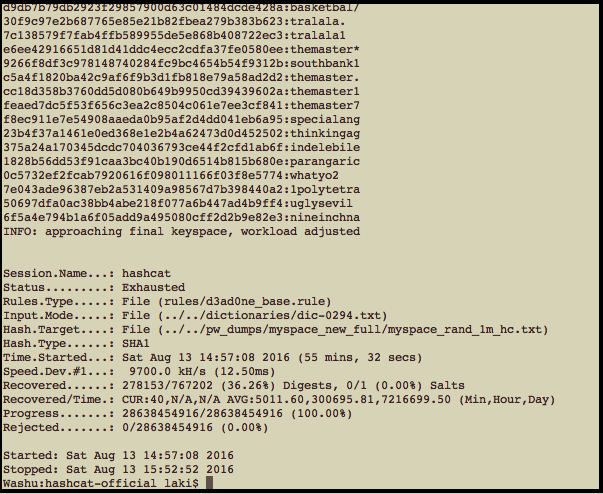
“Only sometimes when we pick and choose among the rules we discover later that we have set aside something precious in the process.”    ― Helen Simonson, Major Pettigrew's Last Stand Background and Problem Statement: I was recently asked the following question: "Is there any value in supporting the character purge rule in Hashcat?"  The purge rule '@x' will remove all characters of a specific type from a password guess. So for example the rule '@s' would turn 'password' into 'paword'. The full thread can be found on the Hashcat forum  here.  The reason behind this inquiry was that while the old version of Hashcat implemented the character purge rule, GPU versions of Hashcat and Hashcat 3.0 dropped support for it. Since then, At0m added support for the rule back in the newest build of Hashcat which makes this question much less pressing. That being said, similar questions pop up all the time and I felt it was worth looking into if...
Cracking the MySpace List - First Impressions

Image
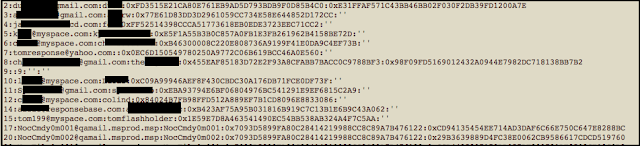
Alt Title: An Embarrassment of Riches Backstory: Sometime around 2008, a hacker or disgruntled employee managed to break into MySpace and steal all the usernames, e-mails, and passwords from the social networking site. This included information covering more than 360 million accounts. Who knows what else they stole or did, but for the purposes of this post I'll be focusing only on the account info. For excellent coverage of why the dataset appears to be from 2008 let me refer you to the always superb Troy Hunt's blog post on the subject . Side note, most of my information about this leak also comes from Troy's coverage. This dataset has been floating around the underground crime markets since then, but didn't gain widespread notoriety until May 2016 when an advertisement offering it for sale was posted to the "Real Deal" dark market website. Then on July 1st, 2016, another researcher managed to obtain a copy and then posted a public torrent of then entir...

Getting Started With Quantum Computing

Image
“More often than not, the only reason we need experiments is that we're not smart enough.”  ― Scott Aaronson IBM is currently offering free time on one of their quantum computers for interested researchers. Yup, you can program a real life quantum computer right now! In fact, I highly recommend signing up which you can do here . Go ahead and check it out. It took me about 24 hours to get my account approved so you can come back here afterwards to finish reading this post. What got me interested in this opportunity was that while I have tried to keep up on the field of quantum computing, it basically is magic to me.  I've been building up some general rules in my head about quantum systems, but any sort of question about them that did more than scratch the surface left me shrugging my shoulders. Also it was hard to separate fact from fiction. Quantum Laws (in Matt's head): Quantum is a system like everything else.  A quantum state is a configuration of the system...

Challenges with Evaluating Password Cracking Algorithms

Image
"In theory, theory and practice are the same. In practice they are not" -Quote from somebody on the internet. Also attributed to Albert Einstein but I've never been able to find the original source to back that up. Back-story: Currently I'm writing a post looking into Hashcat's Markov mode but I found myself starting off by including several paragraphs worth of disclosures and caveats. Or to put it another way: It was a valid point Jeremi brought up and it's something I'm trying to avoid. After thinking about it for a bit I figured this topic was worth its own post. Precision vs Recall:  Part of the challenge I'm dealing with is I'm performing experiments vs writing tutorials. That's not to say I won't write tutorials in the future but designing and running tests to evaluate algorithms is fun and what I'm interested in right now. Why this can be a problem though is that I can get so deep into how an algorithm works tha...

Tool Deep Dive: PRINCE

Image
Tool Name: PRINCE (PRobability INfinite Chained Elements) Version Reviewed: 0.12 Author: Jens Steube, (Atom from Hashcat) OS Supported: Linux, Mac, and Windows Password Crackers Supported:  It is a command line tool so it will work with any cracker that accepts input from stdin Blog Change History: 1/4/2015: Fixed some terminology after talking to Atom 1/4/2015: Removed a part in the Algorithm Design section that talked about a bug that has since been fixed in version 0.13 1/4/2015: Added an additional test with PRINCE and JtR Incremental after a dictionary attack 1/4/2015: Added a section for using PRINCE with oclHashcat Brief Description:   PRINCE is a password guess generator and can be thought of as an advanced Combinator attack . Rather than taking as input two different dictionaries and then outputting all the possible two word combinations though, PRINCE only has one input dictionary and builds "chains" of combined words. These chains can have 1 to N wo...

Don't call it a comeback ... Ok, maybe it is

Image
Has it really been four years since my last post!? Well I guess it has! So a better question is: "What has changed for me to bring this blog back?" Well last February I  got rid of my apartment, took leave of my job, and hiked all 2185.3 miles of the Appalachian Trail from Georgia to Maine. During that time I realized how much blogging meant to me. Long story short, I've been working with my employer to figure out how I could restart this blog now that I'm back. I don't want to spend too much time on this news post but I might as well end it on one more question: "What should you expect?" That's up in the air right now and I plan on remaining flexible, but I feel one thing I have to contribute to the research community is the fact that I really do enjoy constructing and running experiments. I may not be the best coder, l33t3st password cracker, or have a million dollar cracking setup, but I do have mad Excel skills and I love digging into algorit...

CCS Paper Part #2: Password Entropy

Image
This is part #2 in a (mumble, cough, mumble) part serious of posts discussing the results published in the paper I co-authored on the effectiveness of passwords security metrics. Part #1 can be found here . I received a lot of insightful comments on the paper since my last post, (one of the benefits of having a slow update schedule), and one thing that stands out is people really like the idea of password entropy. Here’s a good example: “As to entropy, I think it would actually be a good measure of password complexity, but unfortunately there's no way to compute it directly. We would need a password database comparable in size (or preferably much larger than) the entire password space in order to be able to do that. Since we can't possibly have that (there are not that many passwords in the world), we can't compute the entropy - we can only try to estimate it in various ways (likely poor)” First of all I want to thank everyone for their input and support as I really apprec...